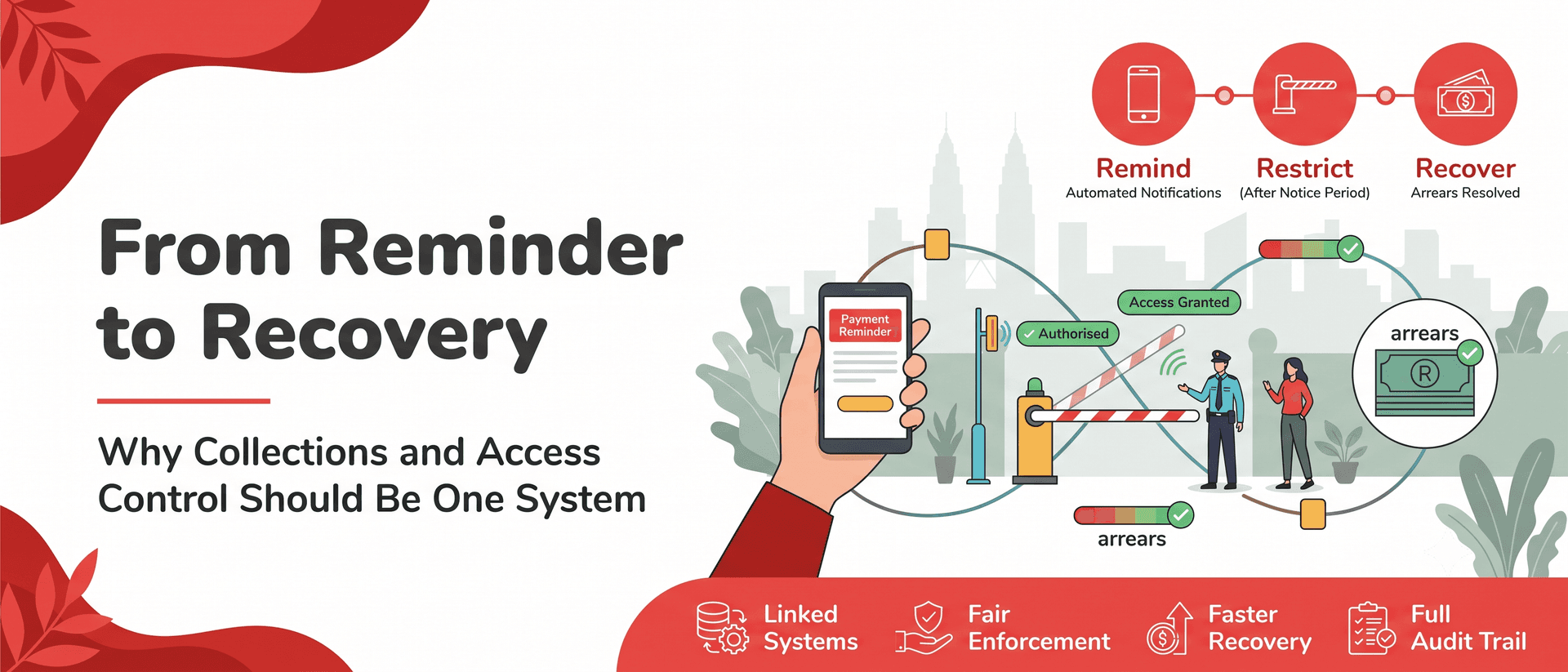
Collections and access control have lived in separate departments for twenty years.
The accountant chases the money. The security team runs the gate. They rarely speak. And that gap — not the defaulter — is why recovery is so slow.
The broken loop
Think about how it usually goes. A resident stops paying. The accounts know. But the gate doesn't — so the defaulter keeps enjoying every facility his paying neighbours fund, while a volunteer treasurer sends increasingly awkward WhatsApp messages into the void. The reminder system and the consequence system never touch.
What happens when you close it
Now connect them. One resident record drives both the ledger and the door. The loop becomes: invoice → automated reminder → debtor aging → flag → by-law-compliant access step → payment → reactivation. Every step logged. No committee member playing debt collector by hand.
The results aren't subtle. Fewer disputes, because everything is on record. Faster recovery, because the consequence is immediate and consistent, not a favour someone remembers to do. And a cleaner conscience, because the same rule applies to everyone.
The catch
This only works if the data is captured once and reused. If your accounting and your access control are two disconnected systems, you can't close the loop — you can only keep sending messages into the void. And it must stay fair and lawful: proper notice, no locking anyone out of their own home, a human in the loop on the judgement calls.
Closing thought
The defaulter problem was never really an enforcement problem. It was an integration problem. Fix the seam between finance and operations, and recovery stops being a monthly battle.
See the JaGaCount + JaGaCard recovery loop:
Sales: hello@jagaapp.com
Sources