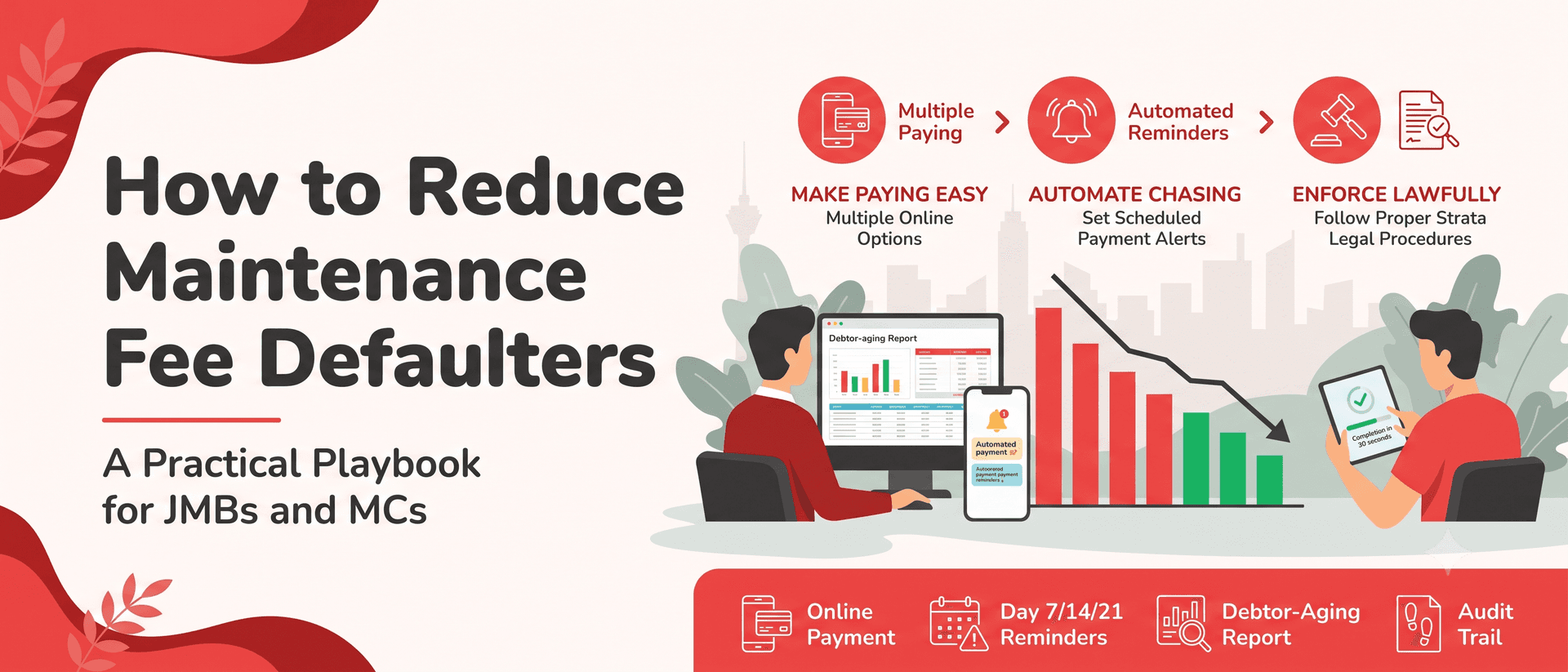
Unpaid maintenance charges are the number-one financial problem in Malaysian strata living. The scale is documented: of the 5,675 cases filed at the Strata Management Tribunal in 2019, 93.23% were for non-payment of maintenance charges and sinking fund contributions. The fastest way to cut your arrears is a three-part system — make paying easy, automate the chasing, and enforce lawfully and consistently under the Strata Management Act 2013.
Why fees go unpaid
It's rarely pure refusal. It's friction (paying is a hassle), silence (no reminders), no visibility (the committee can't see who's behind), and no consequence (nothing happens if you don't pay). Fix those four and most arrears disappear.
What the law lets you do
The SMA 2013 gives management bodies real teeth. Used correctly and consistently, they work:
14-day payment window. Owners must pay charges and sinking fund contributions within 14 days of the notice.
Late-payment interest up to 10% per annum. The JMB/MC may charge interest not exceeding 10% per year on overdue amounts.
Restrict access and facilities — with notice. Under the standard strata by-laws, a management body can generally restrict a persistent defaulter's access, and suspend use of common facilities like the pool or gym, after proper notice. The exact steps depend on your development's by-laws, must be applied consistently, and can never deny an owner access to their own home — so confirm your by-laws before acting.
Recover through the Tribunal. File at the Strata Management Tribunal, which hears claims up to RM250,000; ignoring a Tribunal award is an offence under Section 123 of the SMA 2013.
The 5-step recovery playbook
Make paying effortless. Offer online payment (JaGaPay / e-wallet / FPX) so paying takes 30 seconds, not a trip to the office.
Automate reminders. Send statements of account automatically at Day 7, 14, and 21 — no one has to chase manually (JaGaCount does this).
Make debt visible. Give the committee a weekly debtor-aging report, so arrears are seen early, not at year-end.
Apply fair, consistent consequences. After notice, restrict access and facility use for persistent defaulters where your by-laws allow — applied to everyone equally, with an audit trail.
Escalate. Where arrears remain, file at the Tribunal or recover via the Commissioner of Buildings.
Why the audit trail matters. Consistent, documented enforcement protects the committee as much as it pressures the defaulter. When the same rule is applied to everyone and every step is logged, disputes get far easier to defend.
Frequently asked questions
How many reminders before we take action?
There's no fixed number, but good practice is automated statements at Day 7, 14, and 21, followed by a formal notice before deactivating access or suspending facilities.
Can we restrict a defaulter's access?
Malaysian strata by-laws generally allow a management body to restrict a persistent defaulter's access and facility use after proper notice — but the specifics depend on your development's by-laws, so confirm them (and take advice) before acting. An owner can never be denied access to their own parcel.
Can we bar a defaulter from the swimming pool?
Generally yes. Defaulters can be suspended from common facilities because their unpaid contributions help maintain those facilities. Follow your by-laws and give notice first.
What if the arrears exceed RM250,000?
That's above the Tribunal's limit, so recovery moves to the courts or via the Commissioner of Buildings.
This article is general information for Malaysian communities and is not legal advice. Verify specifics against your own by-laws and seek professional advice where needed.
Automate collections and fair, by-law-compliant enforcement end to end: Sales: hello@jagaapp.com
Sources